Dry Organic Fertilizer Blending: Moisture, Flowability, and Ingredient Sequencing
Dry organic fertilizer blending looks simple from a distance: weigh the inputs, mix the batch, fill the bags. On the plant floor, it is rarely that clean.
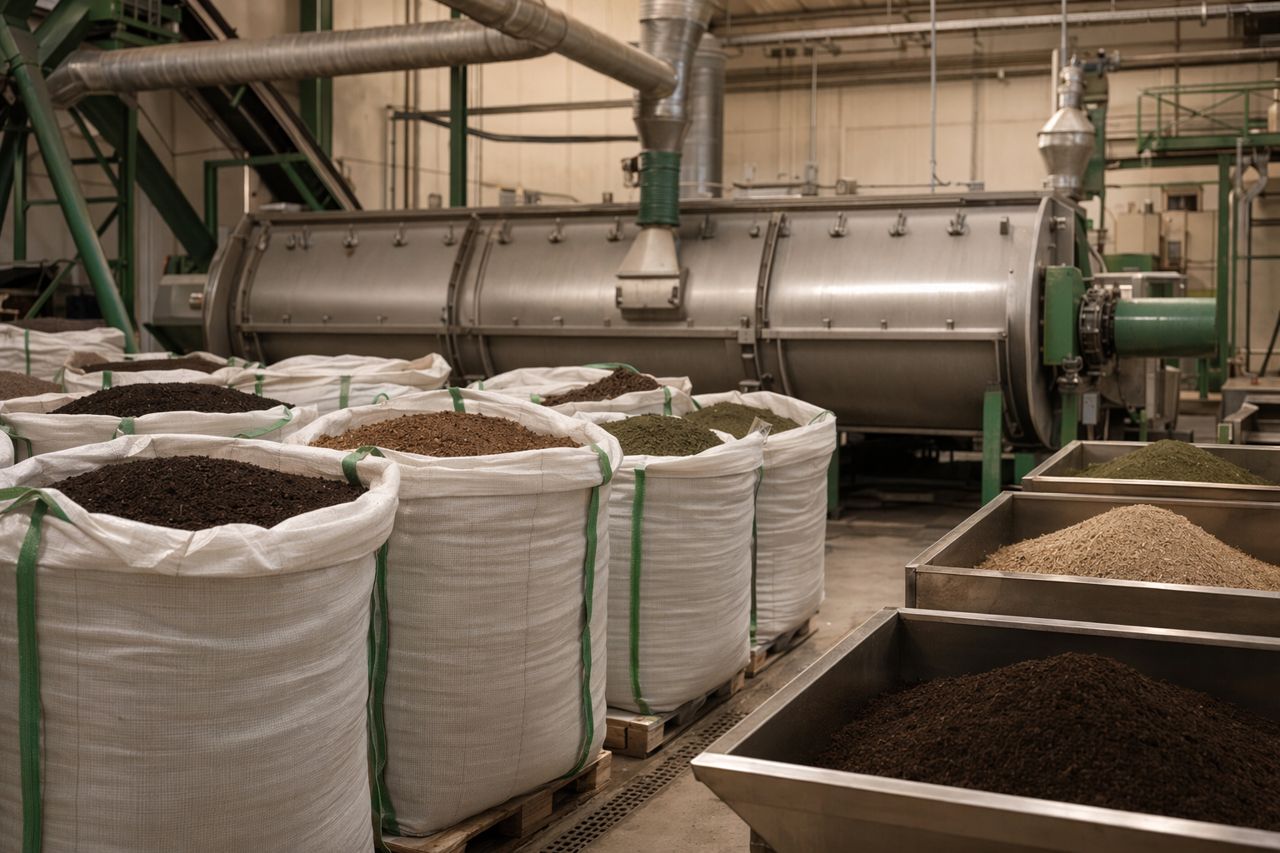
Compost fractions, meals, minerals, carriers, microbial inoculants, humates, extracts, and enzyme-conditioned ingredients all bring different moisture behavior, particle shape, bulk density, and sensitivity to heat or shear. A batch that runs well in the morning can bridge in a hopper by afternoon if humidity rises or if a high-fines ingredient is added too early.
For a biofertilizer manufacturer, the goal is not just a blended product. The goal is a dry product that flows, carries biology reliably, protects organism viability, and reaches the customer with predictable application behavior. As an enzyme supplier for biofertilizer manufacturing, Rootwake Bioprocess supports that goal by helping producers connect upstream substrate conversion with downstream dry handling.
The blending problem is usually not one problem
When a dry organic fertilizer line becomes inconsistent, the visible symptom may be one of these:
- Clumping in the mixer or finished bag
- Bridging in bins, hoppers, or filling heads
- Dusting during transfer and packaging
- Poor distribution of low-inclusion ingredients
- Segregation after blending or during transport
- Heat buildup in a dense or overworked batch
- Declining microbial viability after dry processing
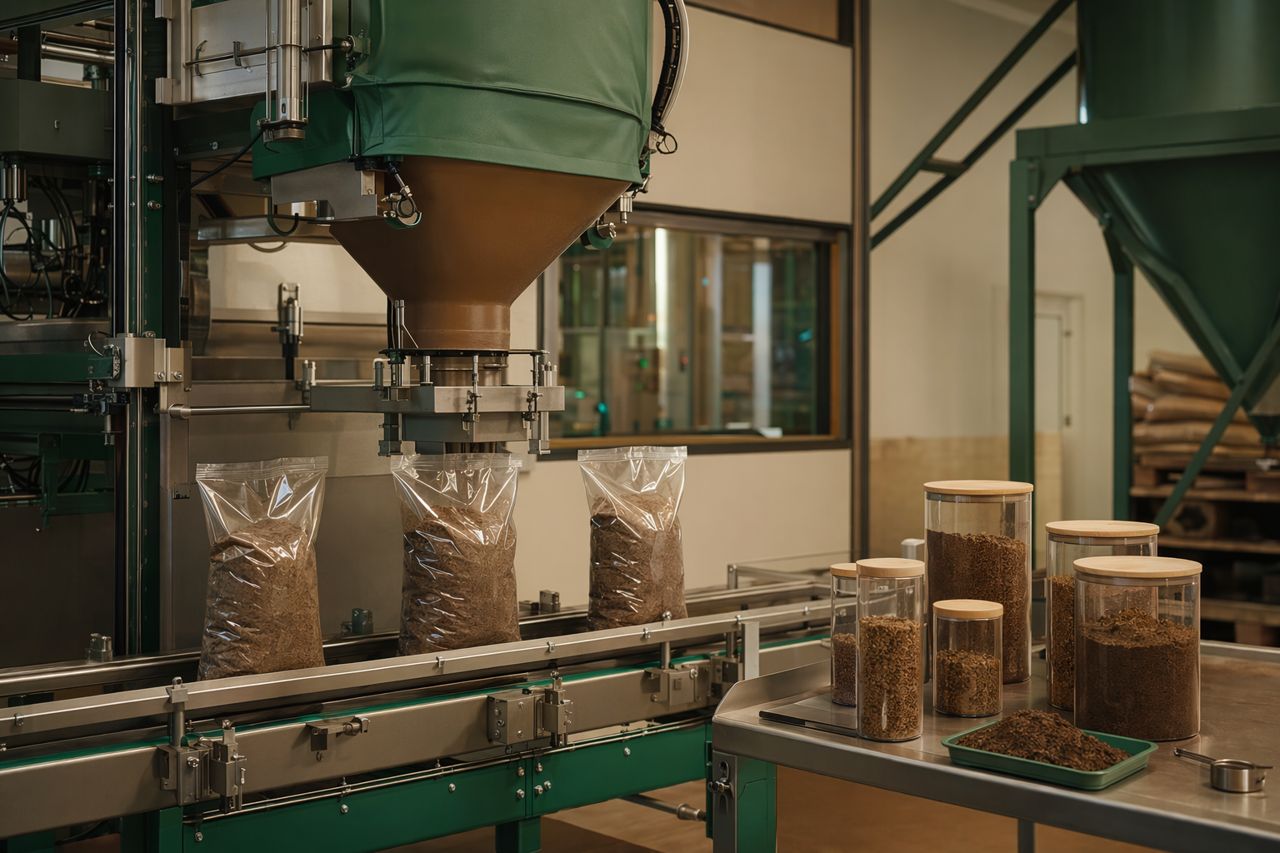
- Variable bag weights due to unstable flow
The root cause is often a combination of moisture, particle-size distribution, ingredient sequence, and handling energy. Solving only one variable may improve the batch temporarily, but a stable process usually requires a practical blending map.
Moisture control starts before the mixer
In dry organic fertilizer manufacturing, moisture is not just a specification on the finished product. It is an operating condition that affects every transfer point.
High-moisture ingredients can smear across mixer walls, capture fines, and create soft agglomerates. Very dry ingredients can generate dust, segregate, or pull moisture from more sensitive biological components. Hygroscopic materials may appear stable at receiving but shift during storage if bags or supersacks are exposed to humid air.
Practical controls for moisture stability
Plant teams can improve repeatability by tracking moisture behavior by ingredient class rather than treating all dry inputs alike.
Key practices include:
- Checking incoming lots for moisture drift before they enter production storage
- Separating high-moisture organics from low-moisture mineral or carrier materials
- Avoiding long open-bin exposure for hygroscopic inputs
- Using covered transfer where humidity swings are common
- Recording seasonal handling changes, not just formulation changes
- Watching for wall buildup, smearing, and soft clumps as early process signals
For biological blends, moisture must be controlled without pushing the product into a condition that stresses the organism package. Too much moisture can reduce flow and shelf stability. Too little moisture can increase dust, mechanical stress, and uneven distribution.
Flowability depends on more than dryness
A dry blend does not automatically flow well. Flowability is shaped by particle geometry, fines load, surface oil, fiber content, electrostatic behavior, and density contrast.
Organic fertilizer ingredients often have irregular surfaces. Meals may compress under load. Compost fractions may contain fibrous particles. Mineral powders may fill voids and tighten the blend. Humates and botanical materials may add fines that influence dusting and packing. Carrier materials can improve distribution, but only when their particle size and surface behavior fit the rest of the batch.
What to monitor on the production floor
Operators can usually identify flow risks before they become packaging delays:
- Does the blend mound sharply or collapse freely after discharge?
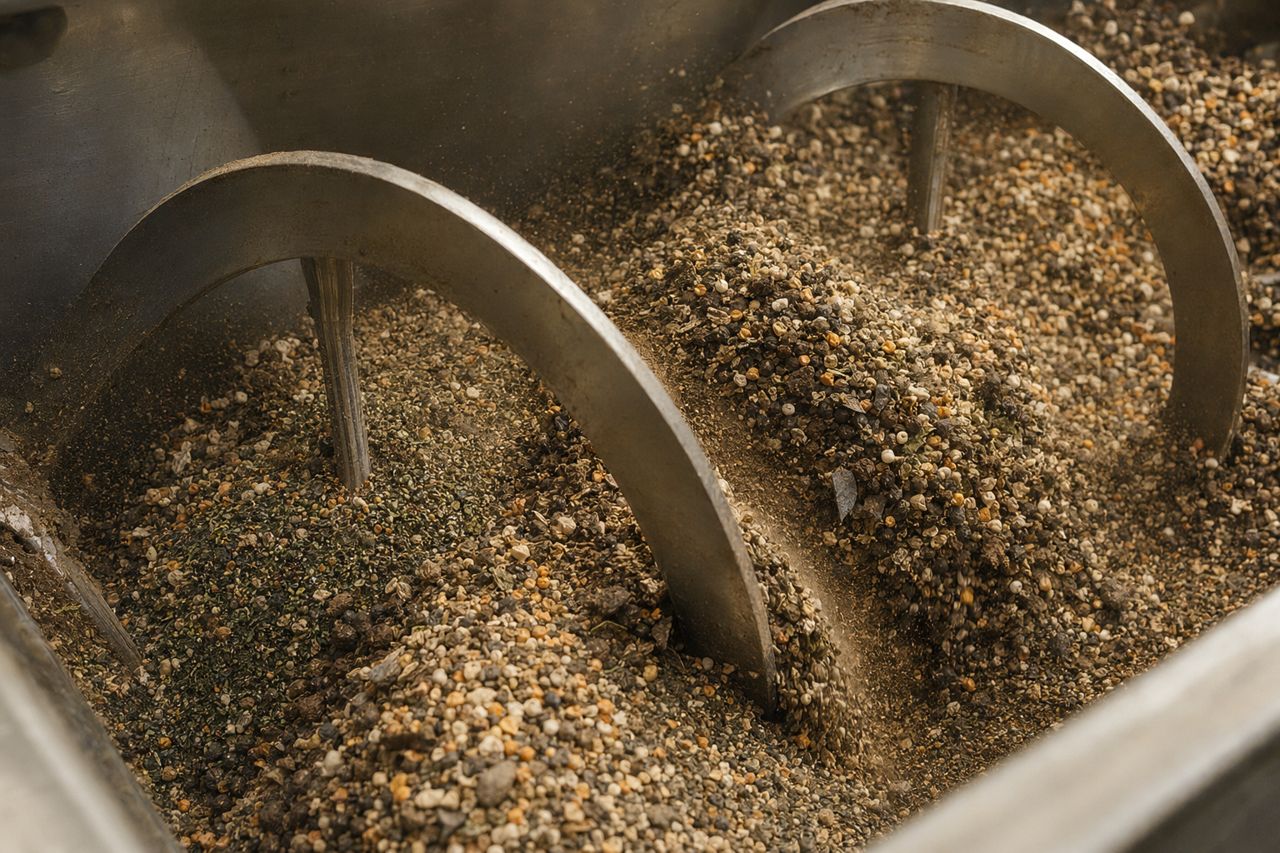
- Does material stick to mixer paddles, ribbon flights, or dead zones?
- Are low-dose ingredients visibly streaking or concentrating?
- Does the bagging line require frequent vibration or manual intervention?
- Does the finished product compact after sitting in a tote or bag?
- Does dust increase after a change in supplier lot or grind profile?
These observations are useful because they connect physical behavior with commercial outcomes: filling speed, rework, customer handling, and product consistency.
Ingredient sequencing is a process tool, not an afterthought
The order of addition can determine whether a dry blend becomes uniform or unstable.
A common mistake is adding sensitive or low-inclusion components too early, then exposing them to unnecessary shear, salt contact, or heat from extended mixing. Another is adding a fine, sticky, or high-moisture material before the bulk carrier has created enough dry surface area to distribute it.
A practical sequencing logic
While every formulation needs its own validation, many dry organic fertilizer systems benefit from this general structure:
- Build the base bed first. Add bulk carriers, stable organic fractions, and compatible mineral materials to establish volume and movement.
- Distribute functional dry inputs. Add amendments that need broad dispersion while the bed is still open and mobile.
- Introduce moisture-sensitive ingredients carefully. Add materials that can clump, smear, or capture fines after adequate dry surface area exists.
- Add microbial and organism-sensitive components late. Reduce unnecessary shear exposure and avoid long contact time with aggressive salts or reactive materials.
- Use a finishing blend, not an overblend. Mix long enough for distribution, but not so long that fines increase, heat builds, or segregation begins after discharge.
Sequencing is especially important when enzyme-conditioned substrates, microbial inoculants, and carrier systems must coexist in the same finished dry product.
Where enzyme strategy connects to dry blending
Enzymes may be used upstream to improve substrate conversion, condition organic inputs, support extract preparation, or improve consistency in feed materials that later enter a dry fertilizer blend. The dry blending line then has to handle the resulting ingredient profile.
For example, an enzyme-conditioned organic input may show different moisture binding, particle surface behavior, or soluble fraction compared with an untreated input. That can be useful for performance, but it must be understood before scale-up. A successful ingredient is not only biologically or chemically functional; it must also move through the plant.
Rootwake Bioprocess supports manufacturers by focusing on production-fit enzyme supply:
- Compatibility with biofertilizer substrates and carrier systems
- Lot-to-lot reliability for repeatable process behavior
- Practical guidance on storage and handling conditions
- Support for upstream conversion goals without ignoring downstream flow
- Documentation that purchasing, quality, and production teams can use
- Supply planning aligned with campaign schedules and batch demand
The best enzyme choice is the one that supports the biological intent of the product and the operating reality of the factory.
Protecting organism viability in dry blends
Dry organic fertilizer lines often include living components: spores, beneficial bacteria, fungi, or other organism packages. These materials do not behave like inert powders.
Viability can be affected by heat, friction, moisture stress, incompatible salts, reactive extracts, and storage exposure. In many plants, the biggest risk is not one severe event. It is the accumulation of small stresses across receiving, staging, blending, holding, filling, and warehousing.
Practical safeguards
Manufacturers can reduce risk by building viability protection into the process route:
- Keep living inputs closed until they are needed
- Avoid staging microbial ingredients near heat sources or humid zones
- Add organism-sensitive components after aggressive mixing steps
- Limit contact time with high-salt or strongly reactive dry materials
- Confirm that carriers are not abrasive or excessively dusty
- Avoid long hold times in partially filled equipment
- Use packaging that protects the moisture window through distribution
A blend can meet its formula on paper and still underperform if the living fraction is damaged by the process. Production design should treat viability as a manufacturing parameter, not only a lab result.
A dry blending checklist for biofertilizer plants
Use this checklist when troubleshooting an existing line or qualifying a new dry organic fertilizer formulation.
Receiving and storage
- Are incoming organic inputs checked for moisture trend and visual consistency?
- Are hygroscopic materials protected from open-air exposure?
- Are high-fines materials isolated or handled with dust controls?
- Are living inputs stored according to their sensitivity profile?
Pre-blend setup
- Are ingredients staged in the intended addition order?
- Are totes, hoppers, and transfer points dry and free of old buildup?
- Is the mixer load size appropriate for movement and turnover?
- Are low-inclusion ingredients pre-dispersed when needed?
Mixing
- Is the base bed moving before sensitive ingredients are added?
- Are sticky or moisture-bearing ingredients given enough dry surface area?
- Are microbial components protected from unnecessary mixing time?
- Is the batch monitored for heat, smearing, dust, and dead zones?
Discharge and packaging
- Does the blend discharge cleanly without bridging?
- Is bag weight control stable across the run?
- Does the product compact, segregate, or dust after filling?
- Are finished bags protected from humidity and temperature swings?
Supplier reliability matters when production windows are tight
Biofertilizer manufacturers operate with real constraints: seasonal demand, batch scheduling, organism lead times, raw material variation, packaging commitments, and customer delivery dates. Ingredient supply cannot be disconnected from those pressures.
A reliable enzyme partner should help reduce production uncertainty, not add another variable. That means clear communication, consistent material quality, practical documentation, and support that understands both biology and plant-floor handling.
Rootwake Bioprocess works with manufacturers that need enzyme inputs aligned with biofertilizer production, not generic catalog language. We help teams evaluate how enzyme solutions fit into substrate preparation, ingredient conditioning, carrier compatibility, and downstream dry handling.
Request a quote
If you are refining a dry organic fertilizer blend, scaling a biofertilizer process, or qualifying enzyme inputs for production, Rootwake Bioprocess can help you assess fit, supply reliability, and handling requirements.
Request a quote through the on-site contact form and share your substrate type, batch scale, process stage, and target handling outcome. We will respond with a practical supply discussion for your production team.